
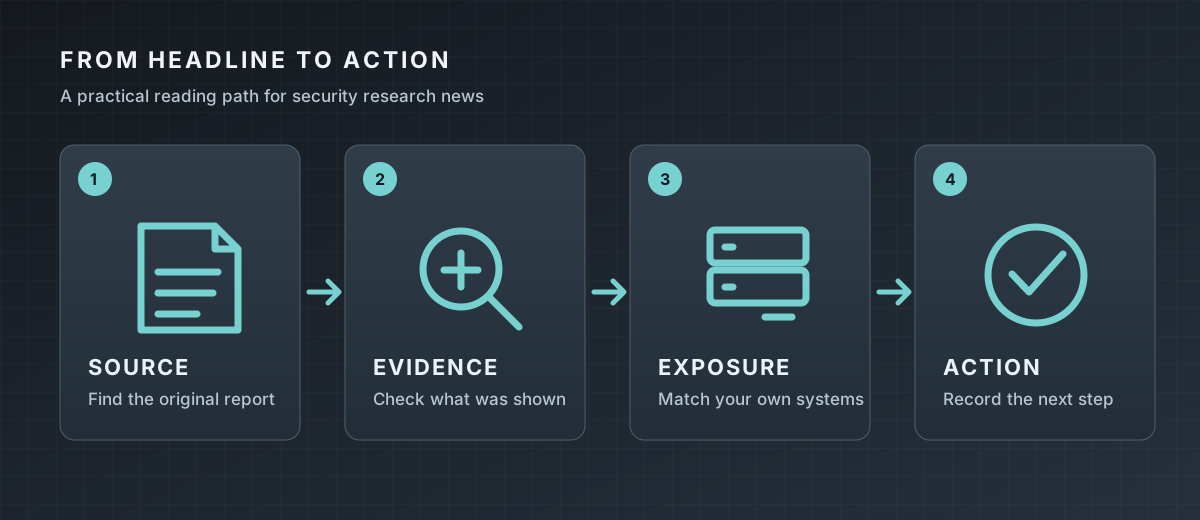
New security stories arrive long before most teams can check them. A dramatic headline might flag a serious problem, yet it seldom explains who is exposed or how the author reached that result. I try to start with two questions: what can I confirm, and does it affect a system I know? The answer will differ across services. A software team and an online casino such as rollambia could see the same report but have different products, versions, and access paths to check. A calm reading habit makes room for curiosity while keeping decisions tied to evidence.
What a headline can and cannot tell you
A headline tells you where to look next. It cannot carry the conditions that make a finding work. One report may require an administrator account; another may depend on an optional feature that few deployments use. A lab demonstration also differs from an attack seen in a real incident. Read the headline as a pointer, then find the affected product, version range, required access, and observed outcome before passing it to anyone else. If the report cannot answer those questions, record the gap instead of filling it with a guess.
| What caught your eye | What to check next | Better place to look |
|---|---|---|
| A new CVE | Does the version match ours? | Vendor advisory and release notes |
| A technique demonstration | Which setup made it possible? | Original research and test notes |
| An incident write-up | Which events were observed? | Timeline and published evidence |
| A detection proposal | Can our logs support it? | Rule logic and example events |
The table identifies missing facts before a team commits to testing, patching, or writing a detection.
A headline is useful when it leads to a testable question, not when it becomes the answer.
Trace claims back to their evidence
Follow a story toward the first source that describes the work. That may be a researcher’s post, a vendor notice, a repository, or a disclosure record. Short summaries are handy for discovery, but they often drop the limits that matter most. Check which versions were tested, what access the tester had, and whether the outcome was reproduced or merely proposed. A screenshot can show that something happened; it rarely proves the full range of systems that could be affected.
Good security research resources answer different questions. The OWASP Web Security Testing Guide explains ways to test web applications. MITRE ATT&CK provides a shared language for observed adversary behavior. NVD search helps locate vulnerability records by identifier. Use these references to frame your reading, then return to the original advisory for product-specific details. No general resource can tell you exactly how your own deployment is configured.
Decide whether a finding matters to your environment
Popularity does not equal local risk. A widely shared flaw in a product you have never installed may be less urgent than a quiet issue in a service you expose to the internet. Compare the report with an inventory, a deployment record, or a conversation with the service owner. Check versions, enabled features, reachability, and the access an attacker would need. If you do not know one of these facts yet, say so plainly. “Unknown” is a useful status because it points to the next check.
A short triage pass keeps the discussion grounded. Bring the original advisory with you so you do not depend on a summary’s wording. Write down uncertain answers and assign someone to confirm them. These questions usually provide enough direction for an initial review:
- Is the named product or component deployed here?
- Which versions run in each environment?
- Is the affected feature enabled and reachable?
- What privileges or access does an attacker need?
- Has exploitation been reported or only shown in a lab?
- Who owns the service and can verify the next step?
The answers can be sorted into four working states. Each state suggests a different first move, not a final verdict.
| What you find | First move | Why it helps |
|---|---|---|
| Exposed affected service | Verify and prioritize mitigation | The reported conditions may apply now |
| Internal affected service | Check access and reachability | Exposure could be limited |
| Version not confirmed | Inventory before scoring | Scope remains unknown |
| Product absent | Record the result and close | No local change is needed |
An affected service still needs an owner and a check against its local controls.
Priority becomes clearer when you can name the affected system and verify the path to it.
Build a small and durable reading routine
Security research blogs are easier to follow when your sources reflect the technology you run. Keep vendor advisories and original research close to the top of the list, then add a few broader sources that help you notice unfamiliar ideas. A brief daily scan can collect leads. A weekly session can verify the strongest ones.
Save promising stories with a sentence about why they matter. A bare link in a chat thread is hard to interpret weeks later. A small shared queue can hold the source, affected asset, open question, and review date. Revisit it often enough to remove items that no longer apply. Research that was relevant to a retired system should not keep competing with current work. A reading list built around these source types is usually enough to begin:
- Vendor advisories for software you deploy.
- Original posts that show methods and limits.
- Maintainer notes for tools your team depends on.
- Vulnerability records with stable identifiers.
- Testing guides with repeatable methods.
- Internal incident notes that explain local context.
Turn research into a useful next action
Finish each review with a decision someone can understand. You might patch, test a configuration, inspect logs, or ask for a version number. You might also confirm that the affected product is absent and close the item. Write the reason beside the decision and give any follow-up a clear owner. That small record stops the same headline from starting a fresh argument next week. It also shows whether the story changed a real control or simply improved your understanding.
Keep tests inside an authorized environment and note both the result and its limits. A successful lab reproduction does not prove that production is exposed; a failed test does not prove safety. For a proposed detection, check that the required events are collected before promising coverage. For a configuration change, ask the service owner what it might disrupt. These checks turn a broad claim into a specific action that can be reviewed without overstating what the research established.
Security research trends are most valuable when they sharpen your questions. Check the source, compare its conditions with your systems, and record what you decided. This habit does not require reading every post or chasing every alert. It gives new ideas a fair hearing while reserving urgent work for exposure you can actually verify. Better decisions, rather than a larger pile of saved headlines, are the measure of a useful news routine.